

The Bloody Prayer
The wounds of Christ and the love that bleeds (52 ways to pray)

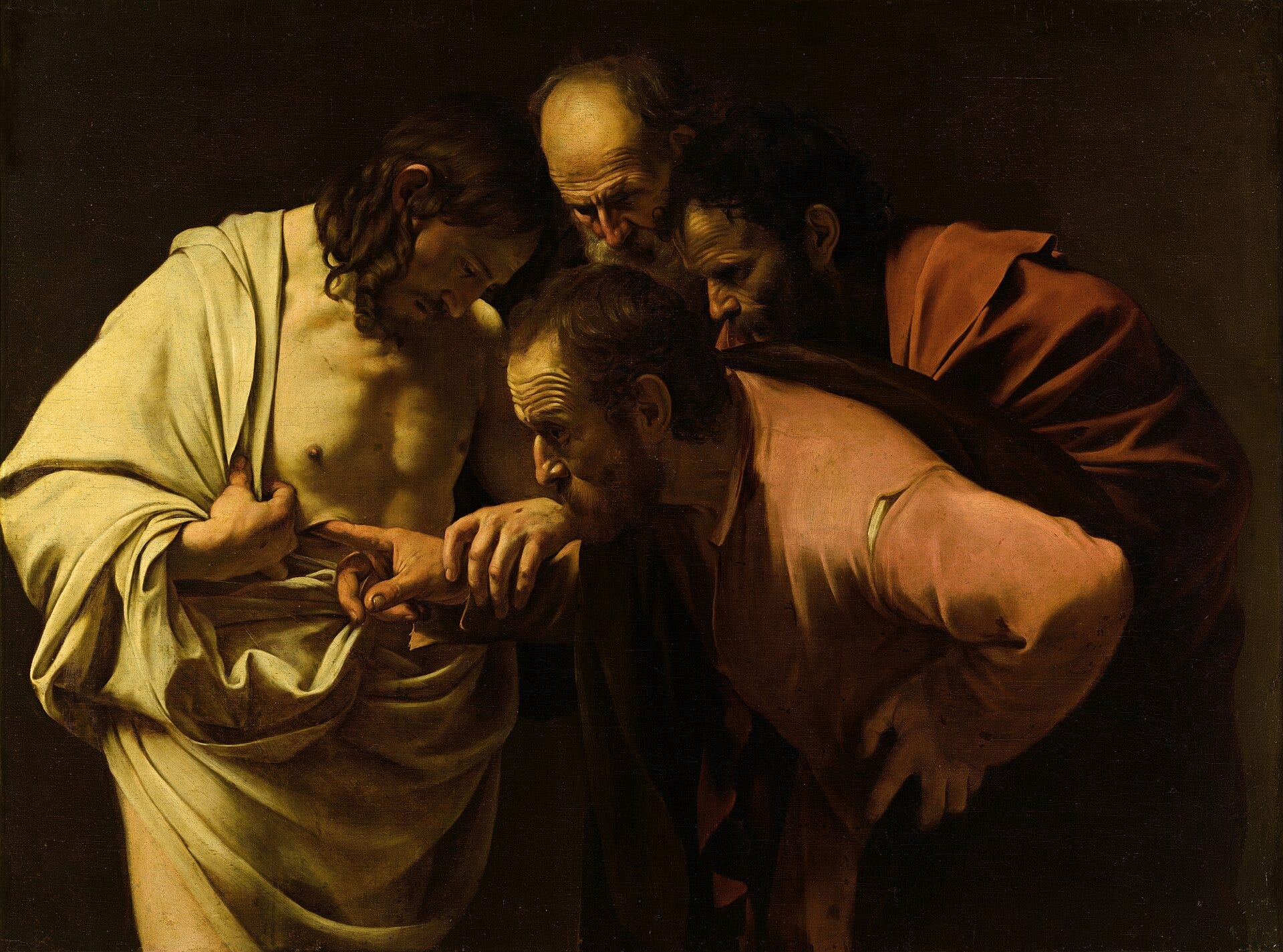
In 2004, Mel Gibson’s The Passion of the Christ debuted. It was sensational for many reasons, but what dominated the public conversation about the film was its gory and gut-wrenching depiction of Jesus’ torture and execution. For the millions who saw it, Christian and non-Christian alike, it was the first time they had considered the cross in terms of flesh-and-blood physicality rather than ethereal theology.
On release weekend, a woman died of a heart attack in a Wichita theater during the film’s climactic scene.
Overwhelmed with remorse after seeing the movie, a man in Texas confessed to an unsolved murder. Another man in Florida turned himself in for a bank robbery he’d committed two years prior.
Debates raged about the appropriateness of depicting the Messiah with such stark violence. Anti-Semitism spiked as some Christians, moved to rage at seeing their Lord brutalized, lashed out.
There was something about seeing Christ’s blood spilled and his flesh torn that evoked an intense, unprecedented response in those who saw it.
Wounds will do that.
In our worship, we love to delight over the victorious, risen body of Christ. We pay homage to the gloom of Good Friday so that we can get on to the sunshine of Easter. Understandably so—our faith stands on the belief that, in the end, Jesus wins.
But in one, somewhat forgotten tradition of prayer, it is Christ’s wounds rather than his resurrection that are the focus.
From the earliest centuries of the church, leaders like Augustine and John Chrysostom emphasized the significance of Christ’s Passion. In the medieval era there came an intensified devotion centered around the “five wounds” of Christ—the punctures to his left and right hands, his left and right feet, and his side.

Many of the most notable female mystics were known for their fervent, and sometimes outright shocking, adoration of Christ’s torn body.
Julian of Norwich, dying and delirious, received a series of sixteen visions of Christ. She saw his discolored face, his lacerated head. “So plenteously the hot blood ran out that there was neither seen skin nor wound, but as it were all blood,” she wrote.
Angela of Foligno wrote that Christ “called to me to place my mouth to the wound in his side. It seemed to me that I saw and drank the blood, which was freshly flowing from his side.”
Catherine of Siena wrote of the open wound in Christ’s side as a place we should seek to hide ourselves within.
If this is making you queasy, you’re not alone. Merely researching for this piece has put my stomach in knots.
But it has also exposed something in me—that way in which I have sanitized and sentimentalized a load-bearing beam of our faith: the Passion of Christ.
The crucifixion is not sterile, sanitary, or sentimental. It is a bloody mess. And if we do not let it confront us, God’s love remains abstract. But when we behold our Savior’s wounds, we see the outrageous extent of God’s love for us—a love that bleeds. And we begin to understand love’s transforming, triumphant power over death.
In seeing the blood gush from Jesus’ flesh, Julian saw God’s love rolling like a river unto us.
The spear meant to deal death turned out to be the spigot that unleashed life.
This is the scandal of the cross at its most visceral—blood becoming wine and water.
And the wounds do something else. They assure us that we are never alone in our suffering. Every time we are ill, injured, or abused—physically, emotionally, spiritually—so is Jesus. He has entered into our suffering. He bears it. He is closer than our own skin.
Practice
The traditional rosary prayer associated with the wounds of Christ invites us to “Meditate and adore the Sacred Wound on the Right Foot,” and on the left foot, the right hand, and so forth.
This prayer is about entering into the reality, however gruesome, of Jesus’ suffering on our behalf. Let it shock you, enrage you, devastate you. And let it minister to you.
It can be helpful to look upon a classic depiction of the crucifixion as you pray. A few suggestions:
Titian’s Crowning with Thorns
Velazquez’s Christ on the Cross
Tiepolo’s The Crucifixion

I also find it generative to touch my own right hand as I contemplate Jesus’ pierced right hand, then my foot, then my side, etc. This is a deeply physical prayer, and making it tactile can help draw us into the reality of it all.
If you’d like a structure, here is a simplified version of the traditional “Adoration of the Holy Wounds.” Go here for the real thing.
Right Hand
Lord Jesus Christ, crucified,
Thank you for the wound of your right hand.
For love, you bore the weight of our sin.
Pause and reflect.
Left Hand
Lord Jesus Christ, crucified,
Thank you for the wound of your left hand.
Have mercy on us sinners.
Pause and reflect.
Right Foot
Lord Jesus Christ, crucified,
Thank you for the wound of your right foot.
Raise up in your people a life of holiness.
Pause and reflect.
Left Foot
Lord Jesus Christ, crucified,
Thank you for the wound of your left foot.
Keep us in this life and in our death.
Pause and reflect.
Side
Lord Jesus Christ, crucified,
Thank you for the wound of your side.
From your opened heart flows mercy.
Pause and reflect.
“Eternal Father, I offer Thee the Wounds of Our Lord Jesus Christ to heal the Wounds of our souls.”
Amen.
Comment below:
What is your honest reaction to focusing on Christ’s wounds like this—drawn in, uncomfortable, resistant? Why do you think that is?
How does focusing on Christ’s suffering change (or challenge) your understanding of God’s love?
If this stirred something in you, share it with a friend:
To receive more posts like this and join the community, subscribe now:
Related practices:
Sweating Blood

In the garden of Gethsemane, on the eve of his crucifixion, we see Jesus at his most human.
Weeping with the World

This is the prayer I have been afraid to write about. Not because it isn’t meaningful—it’s perhaps the most meaningful of any practice in this series. But because it’s so heavy.

Grace and peace.
-gb