

Praying the Hours
The Daily Office (52 Ways to Pray)

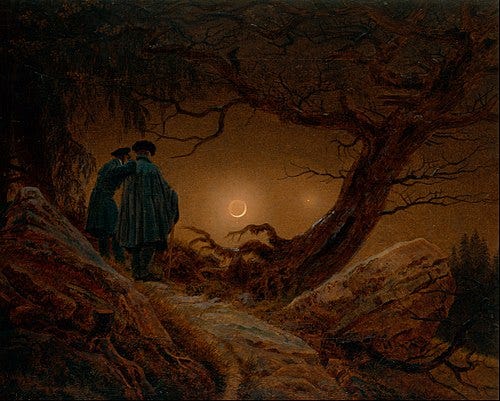
“Ritual” is a word that we’ve become allergic to in the modern church.
We associate it with obligation, with sterility. Much of the seeker-sensitive movement over the past few decades has been a reaction against any form of formality or solemnity in our spiritual lives. We’ve swung toward freedom of expression, personal experience, and “authenticity.”
But what have we swung away from?
I used to recoil from ritual, too. I grew up in evangelical environments that seemed to be the remedy for the lifeless liturgy of the Catholic Church with all their programmed recitations and gestures.
But then I grew up, and I realized that personal emotion is a frail foundation for our spiritual life. Our emotions are fickle, turbulent, subject to all manner of outside influences.
We think that we are being “true to ourselves” when we worship and pray out of emotion, but in reality we’re just being true to whichever way the wind is blowing that day.
Ritual, I’ve come to realize, is a gift.
It puts boundaries on our behaviors that discipline our souls even when our emotions aren’t feeling it. This, I think, is why God gave the Israelites a law, a “rule” of life. It was an act of great grace to guard them against the duplicitousness of their humanity.
James KA Smith writes that rituals “train the heart to desire certain ends.”
One of the foundational rituals of the historic church is The Daily Office.
The earliest roots of the Daily Office appears in the Didache, a sort of early manual for the Christian life that predates even many of the books of the New Testament. The anonymous author instructs Christians to pray the Lord’s prayer three times each day. The tradition of praying at fixed times daily has persisted in the church ever since, taking on various forms.
Early monastics observed the most rigorous version, called The Liturgy of the Hours. Their rhythm looked like this:
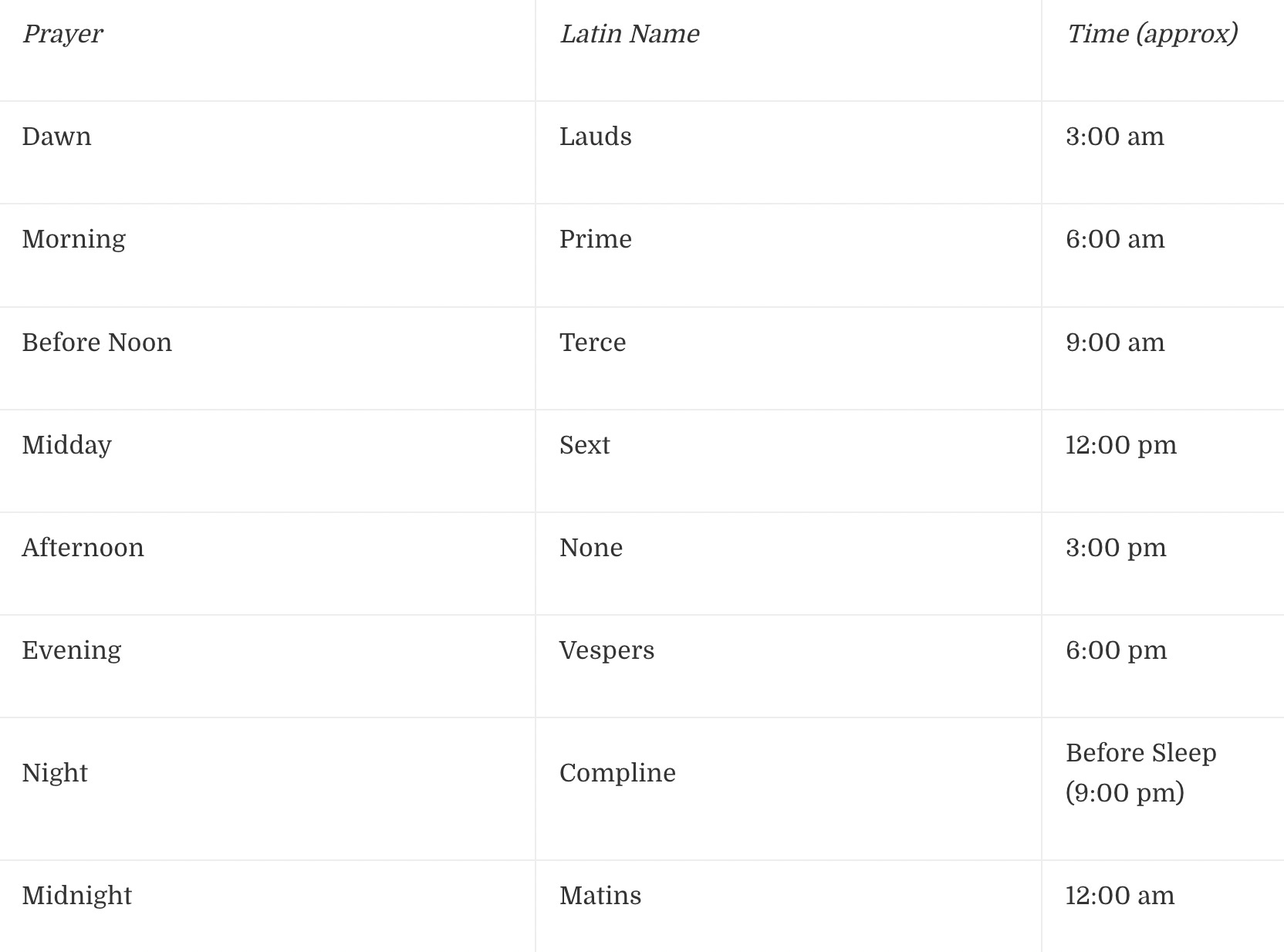
Today, the Anglican church has adopted a simpler ritual of prayer that emphasizes two hours—Morning and Evening.
In all its various forms, the Daily Office is a form of prayer that submits our days to the presence of God.
When we commit to a set schedule of prayer, we declare to our own souls that our time and our lives revolve around the Lord. Our rising and our lying down are synced with worship, like the rising and setting of the sun. Prayer becomes the fulcrum of our day, rather than something we get to if we have time.
This is the path of maturity.
Practice
To begin a Daily Office practice, I recommend the Morning/Evening rhythm of the Anglican church. Once you’ve made a habit of the bookends of the day, you can add in afternoon hours and others.
(Clarifier here—”hour” refers to a set time of prayer, it doesn’t mean that you must literally spend a full hour in prayer. Start with 10 minutes if that’s helpful.)
Set a reminder or calendar event on your phone for a specific time each morning and a specific time each night. It’s simple to pray first when you rise, and last before you go to bed.
What to pray? That’s up to you. The power is in the ritual rhythm.
You can pray the prescribed Anglican liturgy each day. I find that there is something really special about praying the same thing as believers around the world.
I’ve been using The Daily Office App for this.
You could simply choose to pray a Psalm at each of your scheduled hours.
You could use the prayers given in the Lectio 365 app, which is beautifully designed. It will automatically default to the morning or evening prayer of the day based on when you open the app.
You could use any of the other prayer practices that we’ve been exploring here for the past few months. A few suggestions:


Amen.
Comment below:
What rituals—spiritual or otherwise—have quietly shaped your life for the better?
Have you ever tried a fixed prayer rhythm (Daily Office, set prayer times, etc.)? What was your experience?
What resistance do you feel when you hear the word “ritual”? Where do you think that comes from?
If this stirred something in you, share it with a friend who’s craving a deeper way to pray:
To receive more posts like this and join the community, subscribe now:
Grace and peace.
-gb
This is indeed a gift, an opportunity to bathe yourselves in "Psalms, hymns and spiritual songs." Since becoming Catholic 4 years ago, the liturgy of the hours has been a delightful prayer passage, from morning to evening and night!