

Prayer from the Belly
Jonah's prayer, the idolatry of blessing, and the gift of suffering (52 ways to pray)

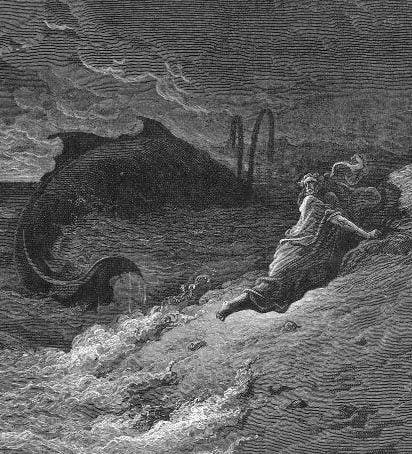
A subtle idolatry has seeped into the modern church—the idolatry of blessing.
When things are well for us, whether in our physical health, our relationships, our careers, or whatever, we are quick to celebrate our flourishing as the evidence of God’s presence in our lives.
But when we are sick, depressed, attacked, or unprosperous, what then do we make of God’s involvement? When blessing becomes our barometer for God’s involvement in our lives, we idolize blessing, bastardize his presence, and we have no framework for dealing with suffering.
God is not the author of evil, we say. But that does not mean that God never authors suffering. In fact any reading of Scripture quickly proves that he does.
Paul’s blindness and Paul’s thorn. Jesus’ temptation in the wilderness. Israel’s humbling in Exodus. Zechariah’s muteness. Jonah’s ordeal in the belly of the fish.
Jonah’s story is one of the most well known in the Bible. After disobeying God’s command to prophesy to Nineveh, he is met with a dangerous storm on the sea, thrown overboard, then swallowed by a great sea beast. There, in the belly of the fish, he waits, and laments, and prays, for three days.
It is a prophetic allegory for Christ’s future descent into the grave. Jesus goes down willingly, for our sake. Jonah goes down shamefully and by force.
The fish stands as a powerful image of the dance between suffering and grace that runs through the entire Christian story. We cannot imagine the horror of being hurled into the churning waves, sure to be drowned, then to be engulfed by a sea monster, sure to be killed.
It is a violent, harrowing sentence. But it is also his salvation. After three days in the depths, Jonah is spat out—his life preserved, his spirit refined, and his assignment renewed.
The fish was a place of suffering, of wilderness, of rebuke. And it was a gracious gift from God. It was both, as God’s working in our lives often is. Any theology that cannot hold suffering and salvation in tension is too juvenile to accommodate the God of the Bible.
Jonah’s prayer is a script for when the human soul reaches its breaking point. It is a confession of utter surrender, when our will finally gives way to God’s.
Its mournful contrition reminds us of the most lamenting Psalms.
Its turn toward hope reads like the most dramatic conversion.
Practice
Before praying, spend some time in reflection on these questions:
What does “the belly of the fish” look like or feel like for you right now?
What afflictions or hardships have you been enduring?
When has God delivered you from something in the past?
How has God used your pain for good in previous seasons?
Where do you sense that God is trying to get your attention or redirect you?
What would deliverance feel like right now?
Now, descend with Jonah, let his prayer give language to your own soul. Feel free to take it slow. If any particular line really speaks to you, stop and linger with it a while.
Jonah’s Prayer (Jonah 2)
“In my distress I called to the Lord,
and he answered me.
From deep in the realm of the dead I called for help,
and you listened to my cry.
3 You hurled me into the depths,
into the very heart of the seas,
and the currents swirled about me;
all your waves and breakers
swept over me.
4 I said, ‘I have been banished
from your sight;
yet I will look again
toward your holy temple.’
5 The engulfing waters threatened me,
the deep surrounded me;
seaweed was wrapped around my head.
6 To the roots of the mountains I sank down;
the earth beneath barred me in forever.
But you, Lord my God,
brought my life up from the pit.
7 “When my life was ebbing away,
I remembered you, Lord,
and my prayer rose to you,
to your holy temple.
8 “Those who cling to worthless idols
turn away from God’s love for them.
9 But I, with shouts of grateful praise,
will sacrifice to you.
What I have vowed I will make good.
I will say, ‘Salvation comes from the Lord.’”
Amen.
Comment below:
Which line of Jonah’s prayer resonates with you the most?
If this stirred something in you, share it with a friend:
To receive more posts like this and join the community, subscribe now:
Related practices:
The School of the Psalms

One of the subtle downfalls of evangelical prayer is the emphasis we place on individuality and freedom of expression.

The Prayer of Repentance

In the age of “attractional” churches, where we have made encouragement, hope, and fun the billboards of our faith, we have let go of an essential aspect of our worship: remorse.

Grace and peace.
-gb
At various times in my life, I too have been a lot like that rogue prophet. Jonah's story has much resonance for me. Thank you for the reminder that the dark place of suffering can also be the realm of blessing.
Greg, this was a powerful post!